Once I Had Polio: Janet Whitworth
Polio
The virus invades the body and does its damage as it travels through the central nervous system. It is different for different people. Before the vaccine we were accustomed to seeing kids on crutches when it attacks the legs, but it may attack the arms. If it attacks the breathing muscles, it may be life threatening without breathing assistance from the iron lung.
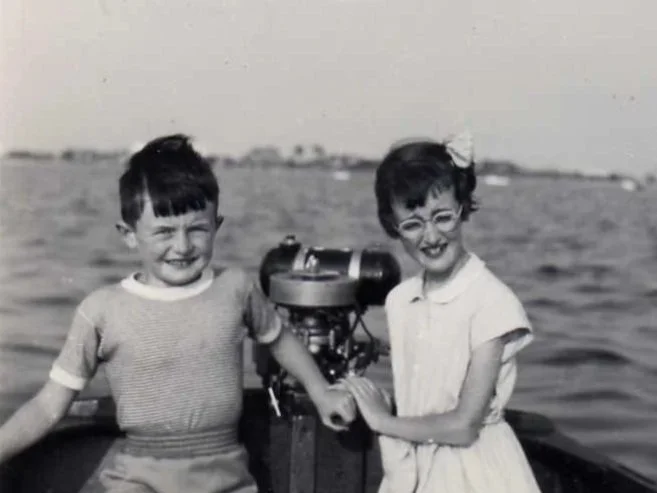
Janet (after polio) and her brother
My Polio
I was only seven when I got polio. My first memory of that experience was struggling to breathe. I had a fever and my breath was very shallow and labored. When they took me to hospital the examination was extremely traumatic. I screamed loudly even though breathing was difficult. Then they placed me in an iron lung. It was a rectangle box and my whole body was inside, just my head was out resting on a shelf with a pillow. Strangely it was a relief because as the machine took over breathing for me, I could relax.
I am not sure how long I needed the iron lung (maybe 2 or 3 weeks). My mother had been a nurse and knew the medical staff, so she was allowed to spend her days with me in isolation. We talked and she turned the pages of a book I was reading that was lying on the glass shelf above my head. Because my mom was with me, I wasn’t scared at all. She was wonderful. Gradually I was weaned off the machine and moved to a hospital bed. At this stage my mother’s main task was to haul my body back up on the pillows, because I would gradually slide down my pillow hill. My left arm and neck were paralyzed.
After a few weeks I was moved to a rehab hospital quite a distance from home. Although Treloar Hospital, Alton, UK was a wonderful hospital I did not like being separated from my mother and felt horribly lonely. My parents could only visit on Sundays for about an hour. However, I received lots of physical therapy and gradually my paralysis faded to just weakness. After months of treatment, I slowly regained strength.
Eventually the day came when I could go home. My parents came with my younger brother who I hadn’t seen in months. I was on top of the world. While I was away they moved to a bigger house with a garden. On our way home, I had to stand up between the bucket seats to tell my parents some important thing or ask about our house. There were no seat belts in those days.
I went home but recovery was still in process for years. Because I had a weak cough I got pneumonia annually. Eventually, it returned every other winter. I was hospitalized several times. Penicillin was the drug of choice until I became allergic to it. Fortunately, by the time I left school I had stopped getting pneumonia and was careful with my health. I could pass for normal. Once I left home, people didn’t know I was a polio survivor. I wasn’t very athletic, but it felt good to be able to blend in.
My Post-Polio
One day, when I was at work, I answered the phone. I moved my mouth to speak but no sound came out. I cleared my throat and my voice worked OK. This happened a few times, so I went to an ENT doctor. He used a tongue depressor and said he couldn’t see anything wrong.
About a month later I had a different problem. My throat was sore and I thought I was getting a cold, so I drank lots of orange juice for vitamin C. Later I learned that all that acid aggravated my problem. I had acid reflux. To protect my lungs from aspirating liquid, my vocal folds (also known as vocal cords) were closing, but because of the polio weakness I could not easily open them to breathe. I was very scared. It happened while I slept, so I was afraid to go to sleep. I was 47 years old.
It took a while for the doctor to understand my problem. They said come back when it is happening (as if that would be possible). Finally, they did X-rays and noted my diaphragm was raised. They asked me if I had had polio. “Yes”, I said, “when I was 7”. Finally, they admitted me to hospital. They saw what happened when my vocal cords closed my airway. First, I was treated with a CPAP machine, but that didn’t prevent the problem, so they inserted a trach tube that I opened at night. During the day I kept it corked. The trach tube allowed me to sleep through the night without the fear of a frightening airway block. It gave my body a chance to recover. Gradually I weaned myself off by leaving the cork in. Then it was removed and I was OK. This was when post-polio syndrome (PPS) was listed as a condition on my health chart.
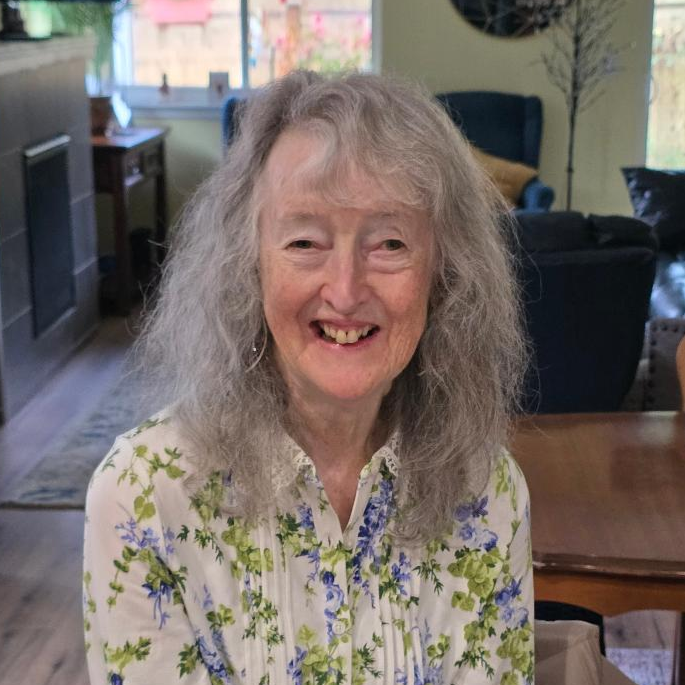
Janet Whitworth
PPS describes the late effects of polio. For some it is a gradual process, for others it may be more sudden if they are in an accident or have another sort of trauma that triggers it. It is not the reemergence of the original virus. It happens because the body rerouted and built-up connections to help with the initial recovery. As time has passed, these new sprouts have worn out from over-use. With PPS the mantra is “Conserve to Preserve” those healthy muscles that remain.
As an analogy I think of a frayed rope on a swing. It’s still holding the swing seat but treat it gently or it could break. When I learned this, I was afraid to exercise but now I do some gentle exercise to help keep my body toned. Doing nothing isn’t good. Moving and stretching within my ability helps prevent atrophy. I always stop if it hurts and be sure to rest. Currently I go the YMCA for chair/yoga. I believe this is good for my body, and has the benefit of social interaction.
Polio Influences One’s Personality:
You fight to overcome the weaknesses; and you try to hide your disabilities.
You just want to blend in with the non-disabled.
You don’t want preferential treatment.
You are independent.
It has been going well for many years. Then PPS hits. You feel more tired and you wish people would see that you need that last chair, but they don’t offer you the seat because you fooled them into thinking you were strong.
You are too proud to ask for help, so you lean on the wall for a while. The years went by and you were proud that you never ever said “I can’t do that because I had polio”. You are a proud survivor.
Now you are wishing you could say “I need to sit down because I am weak. I had polio”, but you still don’t say it because a lot of your contemporaries who aged along with you have other serious health issues from heart disease, cancer, COPD, Parkinson’s, arthritis, hearing loss, vision loss, and the list goes on.
You realize your health issues are not so bad after all. You have empathy. Usually, you still don’t talk about your polio because with age you blended in with your aging friends.
It is important to have friends and keep as active as possible. My life is good and I am truly thankful for the life I have. I have a wonderful family. I loved working, it made me feel useful. Now I am retired and living the dream. I joined a book club, a birthday club, I play cards and do chair/yoga. PPS doesn’t stop me from doing these things. I feel fortunate and blessed to have many wonderful friends.
Janet had polio as a child in England. She now lives in the Seattle, Washington area in the US.